


Product
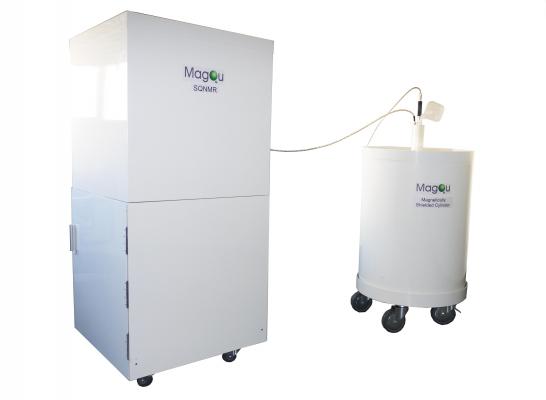
SQNMR
- HTS SQUID-based Low-field NMR
- Low applied magnetic field ~1 Gauss
- T1 and T2 measurement
- HTS SQUID Sensor
- Easy Operation & Maintenance
- With pre-polarization field ~ 500 Gauss
- With field compensation module
In order to achieve high-sensitivity in the detection of weak magnetic signals, the sensitive superconducting quantum interference device (SQUID) is used for NMR detector.
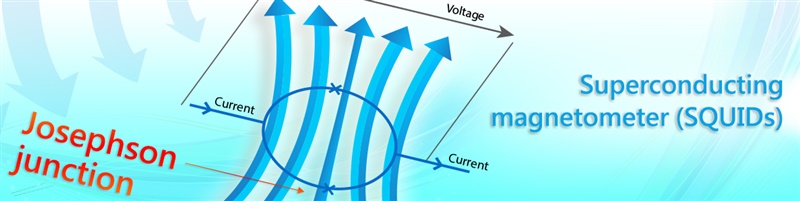
SQUID is a very sensitive magnetometer for extremely weak magnetic fields, based on superconducting loops containing Josephson junctions.
Most SQUID-detected low field NMR systems are set up in magnetically shielded room (MSR). But the MSR require high cost and a large space. MagQu set up a compact and sensitive High-Tc SQUID-detected NMR spectrometer using flux coupling in microtesla field without MSR.
The measuring coil, pre-polarization coil, compensation coils, and gradient coils are set up inside a miniature radio frequency shielded box (RFSB); the SQUID sensor is shielded with a superconducting vessel and installed in a liquid nitrogen cryostat that is seated in a compact magnetically shielded cylinder (MSC). The dimension of the RFSB was 1 m x 1 m x 0.6 m; the MSC is 60 cm in diameter and 70 cm in height. The NMR signals of samples are inductively coupled to the high-Tc SQUID magnetometer via magnetic flux transformer.
Reference
- Hsin-Hsien Chen, Kai-Wen Huang*, Hong-Chang Yang, Herng-Er Horng, and Shu-Hsien Liao*” Optimization of the detection coil of high-Tc superconducting quantum interference device-based nuclear magnetic resonance for discriminating a minimum amount of liver tumor of rats in microtesla fields” , J. Appl. Phys. 114, 064701 (2013).
- S.H. Liao, H.H. Chen, Y.S. Deng, M.W. Wang, K.L. Chen, C.W. Liu, C.I. Liu, H.C. Yang, H.E. Horng, J.J. Chieh, and S.Y. Yang, “Microtesla NMR and high resolution MR imaging using high-Tc SQUIDs”, IEEE Trans. Appl. Supercond. 23, 1602404 (2013).
- K.W. Huang, H.H. Chen, H.C. Yang, H.E. Horng, S.H. Liao, J.J. Chieh, and S.Y. Yang, “Use of a high-Tc SQUID-based nuclear magnetic resonance spectrometer in magnetically unshielded environments to discriminate tumors in rats, by characterizing the longitudinal relaxation rate”, JINST 7, 6005 (2012).
- Shu-Hsien Liao, Chieh-Wen Liu, Hong-Chang Yang, Hsin-Hsien Chen, Ming-Jye Chen, Kuen-Lin Chen, Herng-Er Horng, Li-Min Wang, and Shieh-Yueh Yang, “Spin-spin relaxation of protons in ferrofluids characterized with a high-Tc superconducting quantum interference device-detected magnetometer in microtesla fields”, Appl. Phys. Lett. 100, 232405 (2012).
- Hong-Chang Yang, Chieh-Wen Liu, S.H. Liao, Hsin-Hsien Chen, M.J. Chen, K.L. Chen, Herng-Er Horng, S.Y. Yang, and L.M. Wang, “Temperature and concentration-dependent relaxation of ferrofluids characterized with a high-Tc SQUID-based nuclear magnetic resonance spectrometer”, Appl. Phys. Lett. 100, 202405 (2012).
- Hsin-Hsien Chen, Hong-Chang Yang, Herng-Er Horng, Shu-Hsien Liao, Shieh Yueh, and Li-Min Wang, “A compact SQUID-detected magnetic resonance imaging system under microtesla field in a magnetically unshielded environment”, J. Appl. Phys. 110, 093903 (2011).
- Shu-Hsien Liao, Kai-Wen Huang, Hong-Chang Yang, Chang-Te Yen, M. J. Chen, Hsin-Hsien Chen, Herng-Er Horng, and Shieh Yueh Yang, “Characterization of tumors using high-Tc superconducting quantum interference device-detected nuclear magnetic resonance and imaging”, Appl. Phys. Lett. 97, 263701 (2010)
| Catalog Number | Description | Package Size |
|---|---|---|
| - | - | - |
- Applications Content:Rapid diagnosis for tumor biopsy
- Applications Content:Nutrition analysis for foods